Freedom Isn’t the Goal. Exploration Is
8 minutes

Tom Shepherd
Director of Business Development
Why the enterprises winning with AI are building guardrails and moats, not chaos.
There’s a dangerous narrative emerging in the enterprise AI conversation.
That speed matters more than structure. That experimentation means everyone should use whatever tools they want. That the organisations moving fastest are the ones with the fewest constraints.
At first glance, it feels compelling. AI is evolving weekly. New models arrive overnight. Teams are under pressure to innovate faster than competitors. Boards are asking difficult questions. Employees across the business are already experimenting with AI tools outside official governance.
So the instinctive reaction is understandable: “Just let people use AI.”
But freedom without structure rarely creates transformation. It creates fragmentation, disconnected pilots, and accelerated waste.
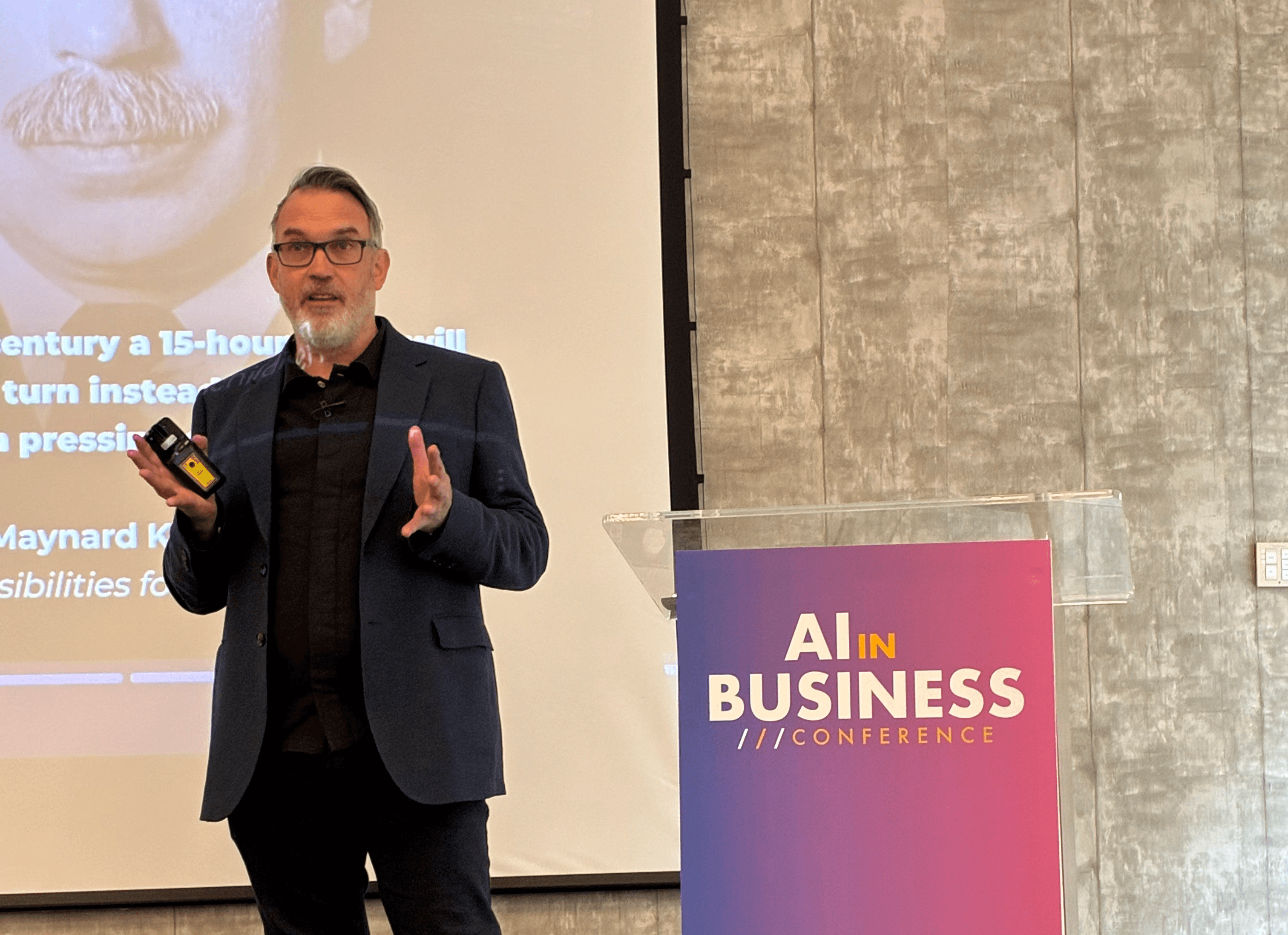
And that was one of the clearest themes emerging from yesterday’s AI in Business Conference: the difference between freedom and exploration.
Because they are not the same thing.
The enterprises that understand that distinction are the ones most likely to create lasting AI advantage.
The Explorer vs The Freedom Fighter
History gives us a useful analogy. The world’s greatest explorers were not reckless. They were disciplined.
Ernest Shackleton didn’t survive Antarctica through chaos. NASA didn’t reach the moon through improvisation. James Cook didn’t map the Pacific by ignoring systems, preparation, navigation, or operational discipline.
Exploration has always depended on structure. Boundaries. Navigation. Shared rules. Clear missions. The purpose of those constraints wasn’t to limit ambition. It was to enable it.
The same principle now applies to AI.
The organisations creating real enterprise value from AI are not giving unrestricted freedom to every team, tool, and workflow. They are creating safe environments for exploration. Guardrails that enable experimentation. Architectures that encourage innovation without compromising trust. Operating models that allow AI to scale safely across the business.
In other words: they are building enterprises full of explorers, not digital cowboys
Why Most AI Transformations Stall
One of the clearest insights from the conference came from Arrie at AstraZeneca: “Technology is the easy bit.”
The harder challenge is organisational, operational, and architectural. Most enterprises are still approaching AI like a tooling exercise rather than a business transformation. They are buying licences, running isolated pilots, and experimenting in silos disconnected from operational reality.
But AI doesn’t transform businesses through isolated experiments. It transforms businesses when intelligence becomes embedded into workflows, operations, systems, and decision-making.
That requires orchestration. Arrie captured this perfectly with a simple formula:
Speed (AI) + Legacy Architecture = Accelerated Waste
As did our own Chief AI Officer, Mark Simpson, quoting Peter Drucker:
“There is surely nothing quite so useless as doing with great efficiency what should not be done at all.”
That’s the productivity paradox many enterprises are now experiencing. AI accelerates activity. But if the underlying operating model is fragmented or constrained by legacy systems, AI simply accelerates inefficiency.
As Arrie described it, it’s like bolting an electric motor onto a Victorian pulley system. You create movement. But not transformation.
And this is where many organisations confuse freedom with progress. Because unrestricted experimentation creates the illusion of momentum. But disconnected experimentation rarely scales.
The model is not the moat. The system is.
The Most Important AI Principle Enterprises Are Missing
One of the most powerful lines from the conference was this: “Brakes are for speed.”
Every high-performance system in the world relies on controlled constraint. Formula 1 cars corner faster because they have better brakes. Aircraft move safely at extraordinary speed because they rely on disciplined operating procedures.
AI is no different.
The enterprises moving fastest with AI are not removing controls. They are designing intelligent controls. And there’s a huge difference between governance that blocks innovation and governance that enables exploration.
Poor governance says: “No.”
Good governance says: “Yes, safely.”
That shift changes everything.
Freedom Creates Anxiety. Exploration Creates Confidence.
Enterprise leaders are currently caught between competing pressures. Employees want flexibility. IT wants control. Compliance wants reassurance. The board wants measurable ROI. Meanwhile, the business wants speed.
This creates a dangerous middle ground where organisations either lock AI down completely or allow uncontrolled experimentation. Both approaches fail. The first kills momentum. The second destroys trust.
The organisations succeeding are doing something far smarter. They are creating governed environments where teams can experiment safely within defined boundaries.
Because what starts as experimentation quickly becomes:
Shadow AI
Duplicate workflows
Siloed copilots
Fragmented data
Technical debt disguised as innovation
Or, more bluntly: Freedom without structure creates enterprise entropy. At the conference, this repeatedly came back to one word:
Trust.
Not trust in the model. Trust in the system. Trust in the architecture. Trust in the governance.
As Gorden from Checkatrade put it: “Trust isn’t a feature. It’s infrastructure.”
And in an AI-enabled enterprise, that may become one of the defining principles of the next decade.
The Enterprise AI Winners Will Build Systems, Not Experiments
One of the strongest themes reinforced both at the conference and throughout our recent whitepaper is this: AI advantage does not come from isolated tooling.
It comes from building repeatable systems. Yet many organisations are mistaking AI activity for AI transformation. Teams are deploying copilots without integration, building disconnected no-code solutions, and solving the same problem five different ways across the business.
That doesn’t create a competitive advantage. It creates fragmentation. The future enterprise moat will not come from who adopted ChatGPT first.
It will come from who built the best intelligence system around their proprietary data, workflows, governance, integrations, customer context, and operational feedback loops. That’s why enterprises need more than experimentation. They need a systematic, repeatable approach for operationalising AI inside their world.
The Importance of a Foundation to Explore
We’re the catalyst for enterprises to move from AI activity to AI advantage through a systematic, repeatable framework for building intelligence into the operating model of the business.
Because the reality is this: most organisations do not struggle to generate AI ideas. They struggle to operationalise them.
They struggle to prioritise the right opportunities, align business and technology stakeholders, move from pilot to production, maintain governance, avoid fragmentation, and scale AI without introducing technical debt or organisational chaos.
That’s why we’ve developed our Intelligence Blueprint and AI Reference Architecture.
Not as static frameworks or technical diagrams. But as a practical system for building scalable, measurable, enterprise-grade AI capability. At the centre of this approach is a belief that the model is not the moat. The system is.
Models will continue to evolve rapidly. Today’s frontier model will eventually become tomorrow’s commodity infrastructure. Competitive advantage will not come from locking yourself into a single tool, vendor, or AI platform. It will come from building an enterprise intelligence layer grounded in your proprietary data, workflows, governance, integrations, and operational context.
At the centre of our approach is a simple belief: The model is not the moat. The system is.
Models will continue to commoditise. Competitive advantage will not come from locking yourself into a single AI vendor or toolset. It will come from building interoperable intelligence systems grounded in your proprietary operational context.
That means architectures that are intentionally model-agnostic, workflow-centric, governance-enabled, and deeply integrated into how the enterprise actually operates.
The goal is not isolated AI experiments.
It’s a repeatable operating system for intelligence — one that allows enterprises to evolve tooling, reuse workflows, govern consistently, and operationalise AI without rebuilding capability every time the market changes.
This is how organisations avoid fragmented “Shadow AI” and instead build reusable systems that compound advantage over time.
Our approach follows three connected pillars:
Human Experience: Defining the real problem worth solving and understanding how people and AI should work together.
Applied Intelligence: Identifying where AI creates genuine operational value, not simply novelty.
AI-Ready Systems: Determining how those capabilities integrate, scale, govern, and operate safely within the realities of the enterprise architecture.
That sequence matters.
Because enterprises do not create lasting competitive advantage by deploying more AI tools than everyone else. They create it by building coherent intelligence systems that continuously learn, integrate, scale, and improve across the organisation. That is the difference between experimentation and transformation. And that is the framework we’re helping enterprises build right now.
The Enterprise AI Winners Will Build Sandboxes, Not Prisons
The smartest organisations are not trying to eliminate experimentation. They are formalising it.
They are creating AI sandboxes: safe environments where teams can experiment rapidly, validate workflows, and build confidence without compromising governance or operational resilience.
This is why AI maturity is increasingly becoming an operating model challenge, not just a technology challenge. The organisations gaining advantage are investing in AI-powered people, AI-scaled operations, and AI-native products, not disconnected pilots or random copilots.
Because the future moat will not come from access to models. Everyone will have that.
The real moat will come from:
Operational discipline
Organisational learning
Integrated workflows
Decision intelligence
Proprietary process knowledge
Trusted systems
Bet on the system, not the model.
The Real Role of Enterprise Leadership in the AI Era
The best enterprise leaders in the AI era will not be the ones pretending to have all the answers. They will be the ones capable of creating environments where exploration can happen safely and repeatedly.
That requires leaders who can combine vision with operational discipline — creating systems where experimentation is commercially aligned, scalable, and trusted across the organisation.
This is why the most effective AI transformations are increasingly being driven by what we describe as Fusion Stakeholders: leaders sitting between business, product, operations, customer experience, and technology.
Not purely technical stakeholders. Not purely commercial stakeholders. But connective tissue leaders capable of turning ambition into operational reality.
Because ultimately, AI transformation is not about deploying models. It is about redesigning how the enterprise works.
Final Thought: Build Explorers
The future does not belong to the organisations with the most AI tools. It belongs to the organisations capable of learning and operationalising intelligence faster than everyone else. But enterprise exploration only works when there is trust, structure, governance, architectural clarity, and operational discipline.
The goal is not unrestricted freedom. The goal is confident exploration.
Because that’s where real transformation happens. Not through chaos. But through intentionally designed systems that allow enterprises to safely experiment, scale intelligence, and continuously compound competitive advantage over time.
That is why we’ve developed the Intelligence Blueprint and AI Reference Architecture. Not as theoretical frameworks. But as practical systems for helping enterprises move from AI activity to AI advantage. Building interoperable, scalable, governance-enabled intelligence products grounded in proprietary data, workflows, integrations, and measurable business outcomes.
Because the organisations that win in the AI era will not simply deploy AI faster. They will build better systems for operationalising it.
If you’re currently navigating the tension between experimentation and enterprise scale, or trying to understand how to create a repeatable AI operating model inside your organisation, speak to me or Mark Simpson about the AI Reference Architecture and how we’re helping enterprises build lasting competitive advantage through applied intelligence.
AI
In-person