The Six Foundations That Turn AI Ambition Into Real Enterprise Outcomes
Enterprises often invest heavily in AI, only to see initiatives stall, fail to scale, or lose trust. The issue is rarely the technology itself.
Through years of delivering custom AI products in complex enterprise environments, we’ve identified six foundations that consistently determine whether AI delivers real, sustained business outcomes or remains stuck in experimentation.
These foundations work together to ensure AI becomes a trusted driver of enterprise value.
Complete our AI Maturity Map to understand where you are today, and what you need to do to unlock AI Advantage.
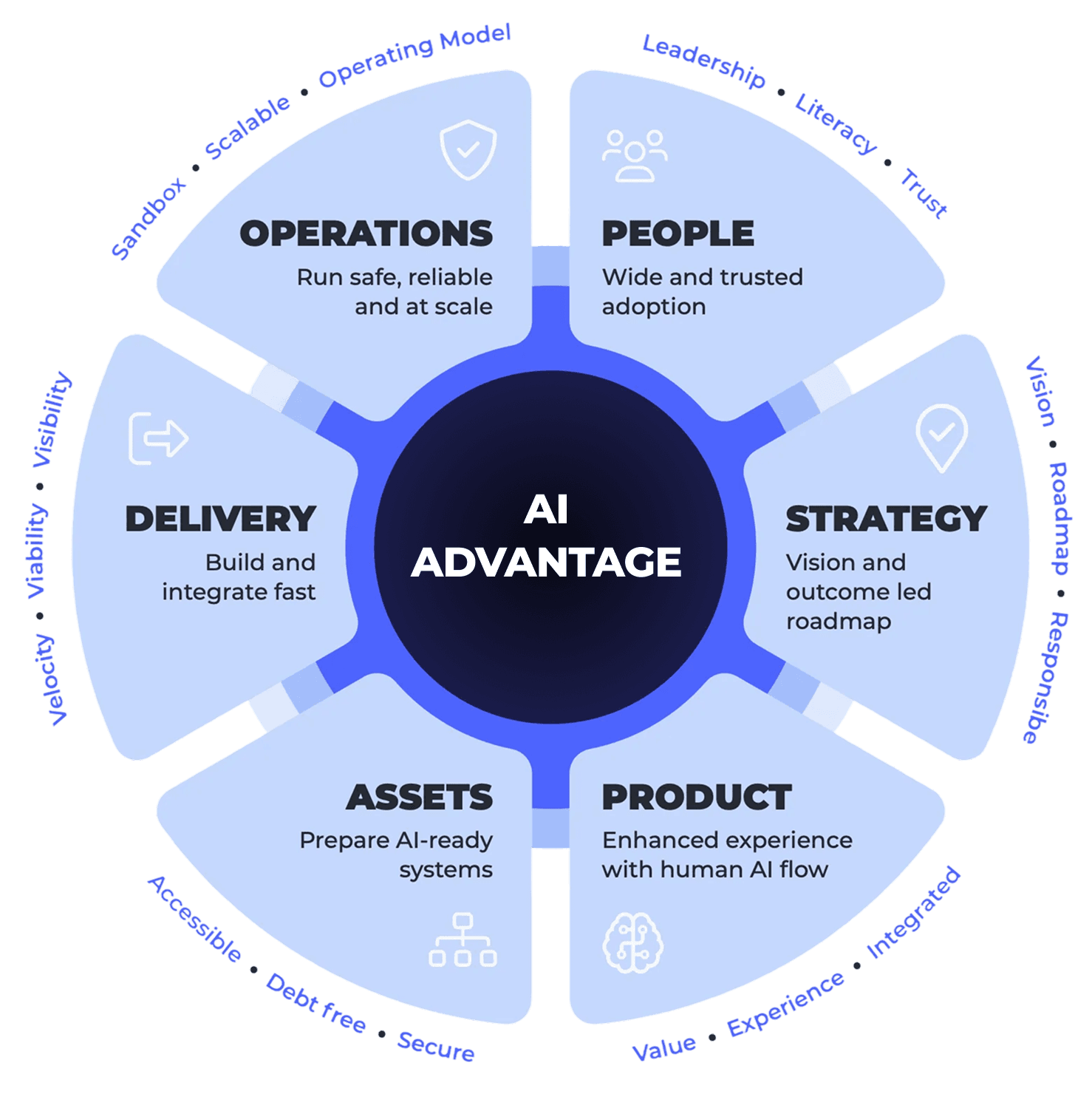

People
Leadership, Literacy, Trust
AI succeeds only when people are ready to use it. It is not just a technology initiative, but a business transformation that requires leadership, literacy, and trust.
Leaders must champion AI with clarity and intent, teams need the confidence to apply it responsibly, and users must trust how it is used. Without this foundation, even well-built AI products struggle to gain adoption or deliver value.

Strategy
Direction, Focus, Responsibility
AI initiatives must be grounded in clear business intent.
A strong strategy connects AI to enterprise goals, prioritises the right opportunities, and provides guardrails for responsible use. Without clear direction, AI efforts fragment into isolated pilots that fail to scale or deliver outcomes.

Product
Value, Experience, Integration
AI delivers impact only when it is built as a product — not a proof of concept.
Successful AI products solve real business problems, provide intuitive user experiences, and integrate seamlessly into existing systems and workflows. AI products cannot be bolt-ons; integration is what turns experimentation into adoption and adoption into measurable results.

Assets
Data, Architecture, Security
AI is only as effective as the foundations beneath it.
Accessible data, fit-for-purpose architecture, and strong security and governance enable AI to perform reliably at scale. When data debt and legacy constraints are ignored, AI initiatives slow down, become costly, or fail altogether.

Delivery
Momentum, Validation, Visibility
AI requires a delivery approach that balances speed with confidence.
Momentum keeps initiatives moving, structured validation ensures viable ideas scale, and unviable ones stop early. Clear visibility builds trust with stakeholders and prevents investment being wasted on initiatives that cannot deliver value.

Operations
Scalability, Reliability, Sustainability
AI advantage is realised after launch, not at deployment.
Solutions must scale safely across the enterprise, operate reliably in production, and fit into a clear operating model. Without this, AI solutions remain fragile, expensive to maintain, or quickly lose relevance.
Reimagine what your business could become in an AI-native world
Most organisations are focused on using AI to improve what they already do.
The bigger opportunity is understanding how AI could reshape your products, services and business model entirely.
Our AI-Native Product Strategy helps leadership teams explore how customer expectations, competitive dynamics and technology are changing, then identify the product opportunities that could create lasting competitive advantage.

The Business Impact
When these six foundations work together, AI stops being an experiment and becomes a strategic enterprise capability.
Organisations gain:
Faster progress from idea to value, without unnecessary risk
Stronger adoption and trust, across business and IT
Differentiated products and services, built on existing enterprise strengths
Sustained efficiency and growth, through scalable, reliable AI solutions
This is how enterprises move beyond pilots and achieve lasting AI advantage.
Chief AI Office, Mark Simpson and Head of Product, Leon Barratt discuss how organisation can close the business gap to drive meaning value from AI. Access the short video below.
A focused conversation to explore your AI ambition, challenges, and where to start, without obligation.